Lunda Designs: Zeroing, Shading and Modulo Arithmetic
How Gerdes turned mirror curves into black-and-white geometric patterns
lunda
gerdes
kolam
lusona
modulo
shading
Author
Arvind V.
Published
November 5, 2026
Introduction
In the module on Mirror Matrices a light ray travelling at 45° between the pulli, reflecting off mirrors, produces a kolam or lusona. Paulus Gerdes observed that the same construction yields a second, equally striking family of figures once we pay attention to the unit squares the ray passes through.
If we colour those unit squares according to a simple rule — most often “black when the row-plus-column index is even, white otherwise,” or more generally modulo (k) — we obtain the high-contrast geometric patterns he named Lunda designs. The colouring rule is completely determined by the path of the ray; equivalently, it can be read off from a chessboard-style “zeroing” of an auxiliary matrix. This short module makes that step explicit and supplies both R and p5.js code so you can experiment with the shading yourself.
From mirror curve to coloured squares
Recall that a rectangle-filling mirror curve passes through every unit square of the grid exactly once (when the dimensions are coprime and the mirrors are “correct”). Number the unit squares by their lower-left corner ((i,j)), where (i) runs over rows and (j) over columns.
Gerdes’ basic observation is:
Colour the square ((i,j)) black if (i+j) is even, white if (i+j) is odd
(or, more generally, colour it according to ((i+j) k)).
Because the ray itself advances by steps of ((,)), consecutive squares it visits always have opposite parity of (i+j). Consequently the colouring is consistent along the whole curve and produces a crisp black-and-white (or (k)-coloured) tiling.
The same rule can be expressed by “zeroing out a chessboard pattern” in a matrix whose entries mark the unit squares: set every entry where (i+j) is even to 0 (or to a background value) and leave the others free to receive the colour of the curve. That is the phrase that appears in the Mirror Matrices module.
A tiny example
Consider a (4) array of unit squares. The parity matrix of (i+j) is
(0 = even, 1 = odd). Colouring even cells white and odd cells black already gives the classic checkerboard Lunda design. When a mirror curve threads through these cells, the black squares it “claims” form one of Gerdes’ characteristic motifs.
R code: parity shading of a mirror curve
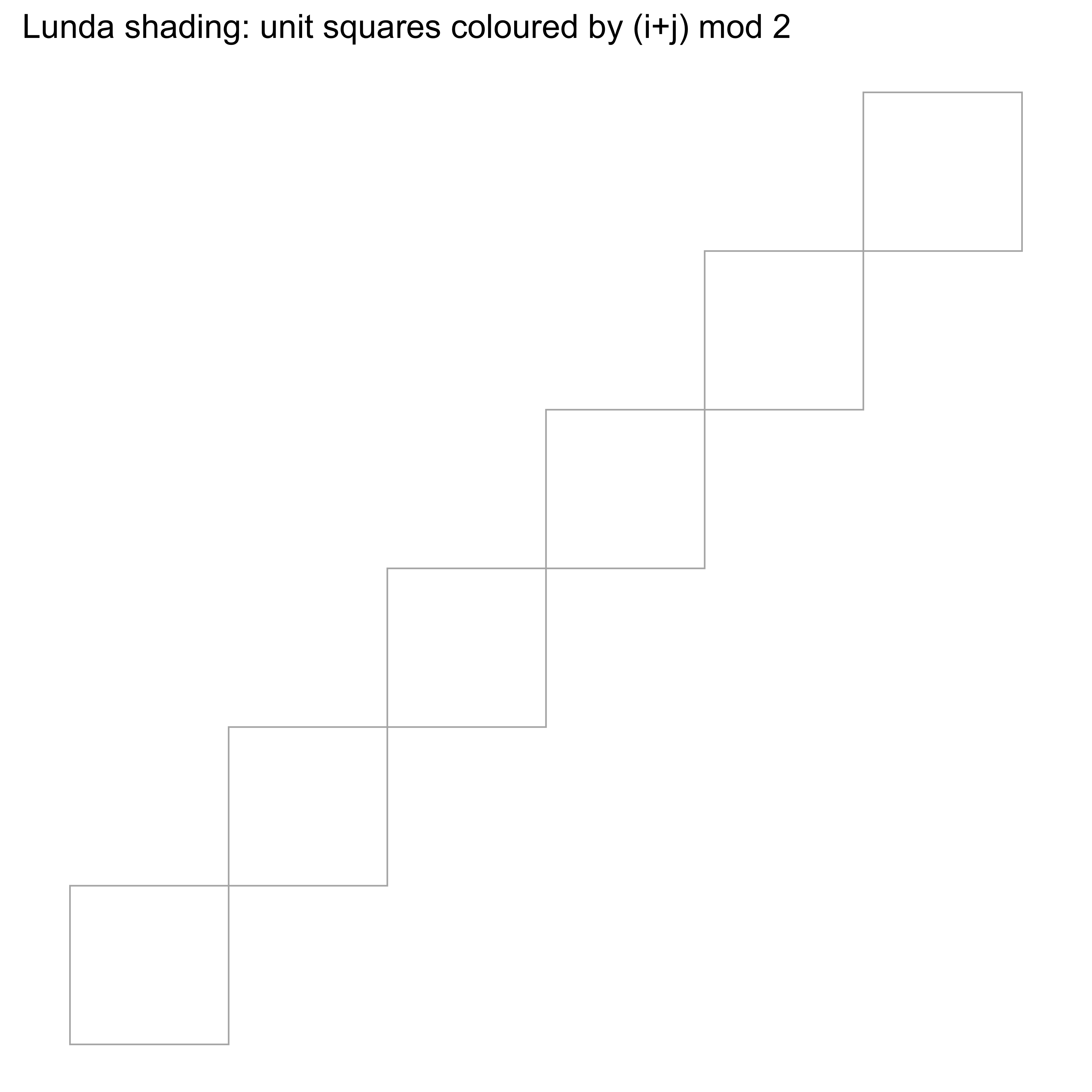
The chunk below re-uses the ray-tracer idea from the Mirror Matrices module, records every unit square the ray enters, and paints those squares according to ((i+j)).
library(ggplot2)# Simple 45° ray on a grid (no internal mirrors for clarity)trace_squares<-function(rows, cols, max_steps=200){x<-0.5y<-0.5dx<-1dy<-1squares<-data.frame(i =integer(), j =integer())for(sin1:max_steps){i<-floor(y)j<-floor(x)if(i>=0&&i<rows&&j>=0&&j<cols){squares<-rbind(squares, data.frame(i =i, j =j))}# bounce off outer wallsif(x+dx*0.5<0||x+dx*0.5>cols)dx<--dxif(y+dy*0.5<0||y+dy*0.5>rows)dy<--dyx<-x+dx*0.5y<-y+dy*0.5if(s>10&&abs(x-0.5)<0.1&&abs(y-0.5)<0.1)break}unique(squares)}sq<-trace_squares(6, 6)sq$parity<-(sq$i+sq$j)%%2sq$fill<-ifelse(sq$parity==0, "white", "black")ggplot(sq, aes(j, i, fill =fill))+geom_tile(colour ="grey70", linewidth =0.3)+scale_fill_identity()+coord_equal()+theme_void()+labs(title ="Lunda shading: unit squares coloured by (i+j) mod 2")
Change the modulus (replace %% 2 by %% 3 or %% 4) to obtain multi-colour Lunda designs. Adding internal mirrors (as in the previous module) simply changes which squares are visited; the colouring rule stays the same.
p5.js sketch: interactive Lunda shading
Paste into the p5.js Web Editor. The sketch draws a 45° ray and colours each unit square it enters according to parity.
// Lunda shading: colour unit squares by (i+j) mod 2// while a 45° ray travels between the pullilet rows =8, cols =8;let cell =50;let margin =40;let path = [];let t =0;functionsetup() {createCanvas(cols*cell +2*margin, rows*cell +2*margin);generatePath();}functiondraw() {background(245);translate(margin, margin);// Draw all unit squares, coloured if visitedlet visited = {};let n =min(floor(t), path.length);for (let k =0; k < n; k++) {let i =floor(path[k].y/ cell);let j =floor(path[k].x/ cell); visited[i+","+j] =true; }for (let i =0; i < rows; i++) {for (let j =0; j < cols; j++) {if (visited[i+","+j]) {fill((i+j) %2===0?255:30); } else {fill(230); }stroke(180);rect(j*cell, i*cell, cell, cell); } }// Pullifill(20);noStroke();for (let i =0; i <= rows; i++)for (let j =0; j <= cols; j++)circle(j*cell, i*cell,6);// RaynoFill();stroke(30,90,180);strokeWeight(2);beginShape();for (let k =0; k < n; k++) vertex(path[k].x, path[k].y);endShape(); t +=0.8;if (t > path.length+30) t =0;}functiongeneratePath() { path = [];let x =0.5*cell, y =0.5*cell;let dx =1, dy =1;for (let s =0; s <300; s++) { path.push({x, y});if (x + dx*cell*0.5<0|| x + dx*cell*0.5> cols*cell) dx =-dx;if (y + dy*cell*0.5<0|| y + dy*cell*0.5> rows*cell) dy =-dy; x += dx * cell *0.5; y += dy * cell *0.5; }}
Design variations
Modulo (k): replace the parity test by (i+j) % k and map the residue to a palette of (k) colours.
Chessboard zeroing: build a matrix that is zero wherever (i+j) is even; the non-zero cells are exactly the ones that receive the “foreground” colour of the Lunda design.
With mirrors: combine the ray-tracer of the Mirror Matrices module with the shading rule above. The mirrors change the route, the modulo rule still colours the squares the route visits.
Exercises
Generate the Lunda design for a (5) grid with no internal mirrors. How many black squares does the single curve claim?
Change the colouring to ((i+j)). Describe the new pattern.
Add one vertical mirror (entry 1 in the Mirror Indicator Matrix) and re-colour. Which squares change colour?
Project. Start from a real network’s adjacency matrix, threshold it to a Mirror Indicator Matrix, trace the resulting curve, and apply Lunda shading. Does any symmetry of the original network survive in the black-and-white design?
References
Paulus Gerdes. Lunda Geometry: Mirror Curves, Designs, Knots, Polyominoes, Patterns, Symmetries. Lulu, 2007. (Chapters on the generation of Lunda-designs and enumeration modulo 2.)
Paulus Gerdes. “On Lunda-designs and some of their symmetries.” Visual Mathematics, 1999.
The phrase “zeroing out a chessboard pattern” that appears in the Mirror Matrices module is exactly the construction shown here: the parity (or modulo-(k)) colouring of the unit squares visited by the mirror curve.
---title: "Lunda Designs: Zeroing, Shading and Modulo Arithmetic"subtitle: "How Gerdes turned mirror curves into black-and-white geometric patterns"author: "Arvind V."date: "2026-11-05"categories: [lunda, gerdes, kolam, lusona, modulo, shading]format: html: toc: true toc-depth: 3 code-fold: false code-tools: true---## IntroductionIn the module on [Mirror Matrices](mirror-matrices-kolam.qmd) a light ray travelling at 45° between the pulli, reflecting off mirrors, produces a kolam or lusona. Paulus Gerdes observed that the same construction yields a second, equally striking family of figures once we pay attention to the *unit squares* the ray passes through.If we colour those unit squares according to a simple rule — most often “black when the row-plus-column index is even, white otherwise,” or more generally modulo \(k\) — we obtain the high-contrast geometric patterns he named **Lunda designs**. The colouring rule is completely determined by the path of the ray; equivalently, it can be read off from a chessboard-style “zeroing” of an auxiliary matrix. This short module makes that step explicit and supplies both R and p5.js code so you can experiment with the shading yourself.## From mirror curve to coloured squaresRecall that a rectangle-filling mirror curve passes through every unit square of the grid exactly once (when the dimensions are coprime and the mirrors are “correct”). Number the unit squares by their lower-left corner \((i,j)\), where \(i\) runs over rows and \(j\) over columns.Gerdes’ basic observation is:> Colour the square \((i,j)\) black if \(i+j\) is even, white if \(i+j\) is odd> (or, more generally, colour it according to \((i+j) \bmod k\)).Because the ray itself advances by steps of \((\pm 1,\pm 1)\), consecutive squares it visits always have opposite parity of \(i+j\). Consequently the colouring is consistent along the whole curve and produces a crisp black-and-white (or \(k\)-coloured) tiling.The same rule can be expressed by “zeroing out a chessboard pattern” in a matrix whose entries mark the unit squares: set every entry where \(i+j\) is even to 0 (or to a background value) and leave the others free to receive the colour of the curve. That is the phrase that appears in the Mirror Matrices module.## A tiny exampleConsider a \(4\times 4\) array of unit squares. The parity matrix of \(i+j\) is$$\begin{bmatrix}0 & 1 & 0 & 1 \\1 & 0 & 1 & 0 \\0 & 1 & 0 & 1 \\1 & 0 & 1 & 0\end{bmatrix}$$(0 = even, 1 = odd). Colouring even cells white and odd cells black already gives the classic checkerboard Lunda design. When a mirror curve threads through these cells, the black squares it “claims” form one of Gerdes’ characteristic motifs.## R code: parity shading of a mirror curveThe chunk below re-uses the ray-tracer idea from the Mirror Matrices module, records every unit square the ray enters, and paints those squares according to \((i+j)\bmod 2\).```{r}#| label: lunda-shading-r#| echo: true#| fig-width: 6#| fig-height: 6library(ggplot2)# Simple 45° ray on a grid (no internal mirrors for clarity)trace_squares <-function(rows, cols, max_steps =200) { x <-0.5; y <-0.5 dx <-1; dy <-1 squares <-data.frame(i =integer(), j =integer())for (s in1:max_steps) { i <-floor(y); j <-floor(x)if (i >=0&& i < rows && j >=0&& j < cols) squares <-rbind(squares, data.frame(i = i, j = j))# bounce off outer wallsif (x + dx*0.5<0|| x + dx*0.5> cols) dx <--dxif (y + dy*0.5<0|| y + dy*0.5> rows) dy <--dy x <- x + dx*0.5 y <- y + dy*0.5if (s >10&&abs(x-0.5)<0.1&&abs(y-0.5)<0.1) break }unique(squares)}sq <-trace_squares(6, 6)sq$parity <- (sq$i + sq$j) %%2sq$fill <-ifelse(sq$parity ==0, "white", "black")ggplot(sq, aes(j, i, fill = fill)) +geom_tile(colour ="grey70", linewidth =0.3) +scale_fill_identity() +coord_equal() +theme_void() +labs(title ="Lunda shading: unit squares coloured by (i+j) mod 2")```Change the modulus (replace `%% 2` by `%% 3` or `%% 4`) to obtain multi-colour Lunda designs. Adding internal mirrors (as in the previous module) simply changes which squares are visited; the colouring rule stays the same.## p5.js sketch: interactive Lunda shadingPaste into the [p5.js Web Editor](https://editor.p5js.org). The sketch draws a 45° ray and colours each unit square it enters according to parity.```javascript// Lunda shading: colour unit squares by (i+j) mod 2// while a 45° ray travels between the pullilet rows =8, cols =8;let cell =50;let margin =40;let path =[];let t =0;function setup(){createCanvas(cols*cell +2*margin, rows*cell +2*margin);generatePath();}function draw(){background(245);translate(margin, margin);// Draw all unit squares, coloured if visited let visited ={}; let n =min(floor(t), path.length);for(let k =0; k < n; k++){ let i =floor(path[k].y/ cell); let j =floor(path[k].x/ cell); visited[i+","+j]=true;}for(let i =0; i < rows; i++){for(let j =0; j < cols; j++){if(visited[i+","+j]){fill((i+j)%2===0?255:30);}else{fill(230);}stroke(180);rect(j*cell, i*cell, cell, cell);}}// Pullifill(20);noStroke();for(let i =0; i <= rows; i++)for(let j =0; j <= cols; j++)circle(j*cell, i*cell,6);// RaynoFill();stroke(30,90,180);strokeWeight(2);beginShape();for(let k =0; k < n; k++)vertex(path[k].x, path[k].y);endShape(); t +=0.8;if(t > path.length+30) t =0;}function generatePath(){ path =[]; let x =0.5*cell, y =0.5*cell; let dx =1, dy =1;for(let s =0; s <300; s++){ path.push({x, y});if(x + dx*cell*0.5<0|| x + dx*cell*0.5> cols*cell) dx =-dx;if(y + dy*cell*0.5<0|| y + dy*cell*0.5> rows*cell) dy =-dy; x += dx * cell *0.5; y += dy * cell *0.5;}}```## Design variations-**Modulo \(k\)**: replace the parity test by `(i+j)% k` and map the residue to a palette of \(k\) colours.-**Chessboard zeroing**: build a matrix that is zero wherever \(i+j\) is even; the non-zero cells are exactly the ones that receive the “foreground” colour of the Lunda design.-**With mirrors**: combine the ray-tracer of the Mirror Matrices module with the shading rule above.The mirrors change the route, the modulo rule still colours the squares the route visits.## Exercises1. Generate the Lunda design for a \(5\times 5\) grid with no internal mirrors.How many black squares does the single curve claim?2. Change the colouring to \((i+j)\bmod 3\).Describe the new pattern.3. Add one vertical mirror(entry 1 in the Mirror Indicator Matrix) and re-colour.Which squares change colour?4.**Project.** Start from a real network’s adjacency matrix, threshold it to a Mirror Indicator Matrix, trace the resulting curve, and apply Lunda shading.Does any symmetry of the original network survive in the black-and-white design?## References1. Paulus Gerdes.*Lunda Geometry: Mirror Curves, Designs, Knots, Polyominoes, Patterns, Symmetries*.Lulu,2007.(Chapters on the generation of Lunda-designs and enumeration modulo 2.)2. Paulus Gerdes. “On Lunda-designs and some of their symmetries.” *Visual Mathematics*,1999.3. Companion module [Mirror Matrices: From Networks to Kolams, Lusona and Rangoli](mirror-matrices-kolam.qmd).---*The phrase “zeroing out a chessboard pattern” that appears in the Mirror Matrices module is exactly the construction shown here: the parity(or modulo-\(k\)) colouring of the unit squares visited by the mirror curve.*