Randomness + Iterative Functions = Symmetry on Average
Symmetric Chaos and Density Patterns
The Central Idea
A single chaotic trajectory cannot be periodic, so it cannot possess a non-trivial symmetry.
Yet when we look at the density of a long orbit (or the attractor itself), clear symmetry often appears.
This is “symmetry on average”—the phenomenon explored in Field & Golubitsky’s Symmetric Chaos.
The mechanism is simple: iterate a map that commutes with a symmetry group (an equivariant map). The attractor is then invariant under that group.
Classic symmetric icon map (order 5)
# Field–Golubitsky style map tuned for visible structure (not a solid disk)icon<-function(z, lambda=-1.8, alpha=2.0, gamma=1.0, m=5){r2<-Mod(z)^2(lambda+alpha*r2)*z+gamma*Conj(z)^(m-1)}n<-150000z<-0.1+0.3ipts<-complex(n)for(iin1:n){z<-icon(z)pts[i]<-z}pts<-pts[-(1:2000)]# discard transientpts<-pts[abs(pts)<2]# keep only the attractor regiondf<-data.frame(x =Re(pts), y =Im(pts))ggplot(df, aes(x, y))+stat_bin2d(bins =80)+scale_fill_viridis_c(option ="inferno", trans ="log10", na.value ="black")+coord_fixed()+theme_void()+theme( legend.position ="none", plot.background =element_rect(fill ="black", color =NA))
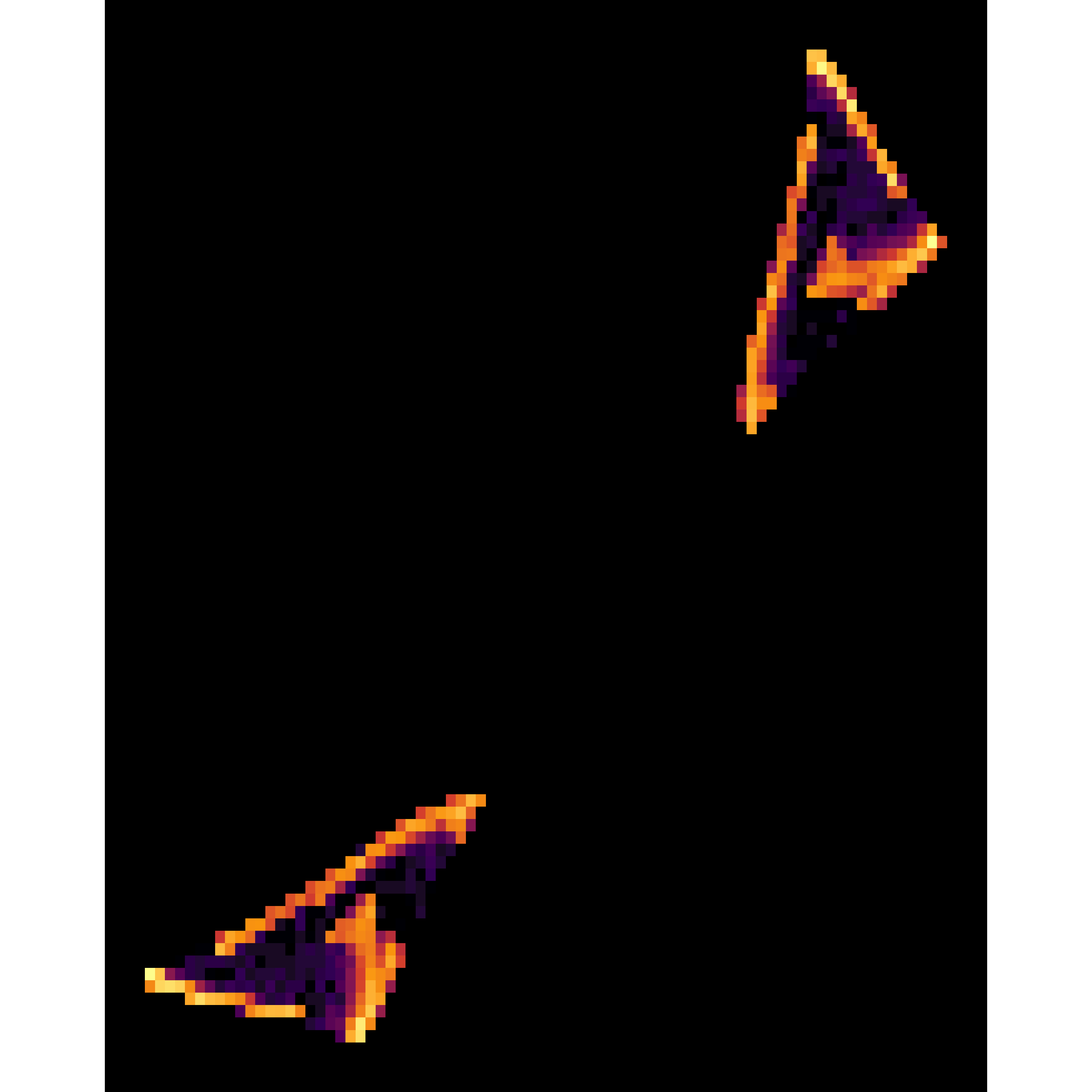
Density plot of a 5-fold symmetric chaotic attractor
p5.js: interactive density accumulation
The sketch accumulates points; color cycles slowly. The five-fold symmetry emerges from the density.
Chaos Game as a Special Case
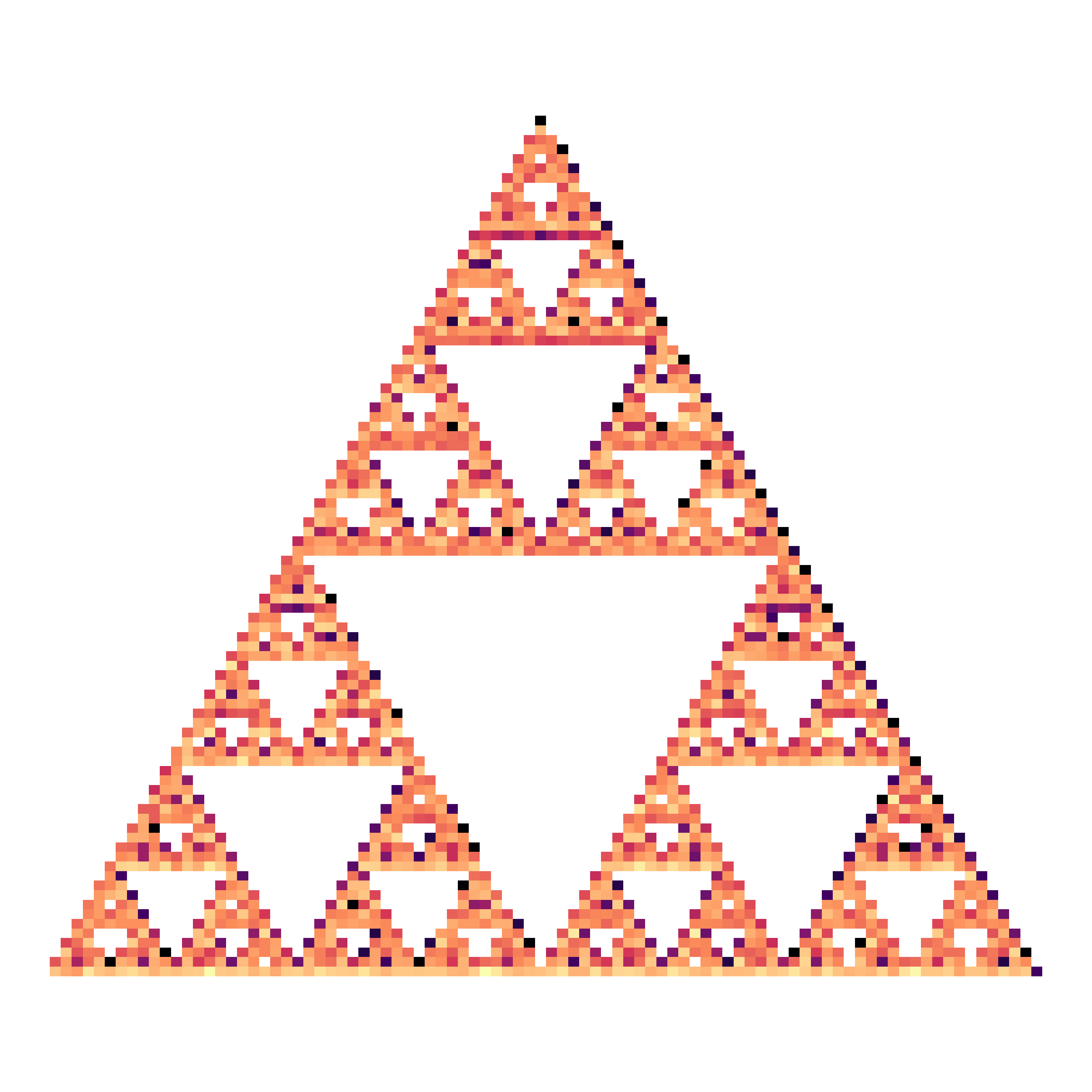
The chaos games of Document 2 are exactly this phenomenon for piecewise-linear equivariant maps.
The “average” (the histogram of visits) is the symmetric attractor.
Equivariance is the design constraint: write (or choose) a rule that treats symmetric points the same way. The long-term picture will automatically be symmetric.
Color = density: the aesthetic decisions move to palette, contrast, and which regions you emphasize—exactly as in the Field–Golubitsky images.
Parameters are knobs: small changes in coefficients produce continuous families of related symmetric designs. This is parametric generative art with a mathematical guarantee of symmetry.
From instantaneous to average: the same idea appears in physical systems (Faraday waves, etc.). A single frame may look noisy; the time average reveals the symmetry.
Minimal working formula (copy-paste ready)
For cyclic symmetry of order ( m ):
[ z_{n+1} = (+ |z_n|^2) z_n + ^{m-1} ]
(with optional small imaginary term ( iz ) to break pure reflection symmetry and obtain pure rotational symmetry).
Iterate from a random start, discard the first thousand points, and color by visit count. That is the entire pipeline from the 1995 paper, reduced to a few lines of code.